
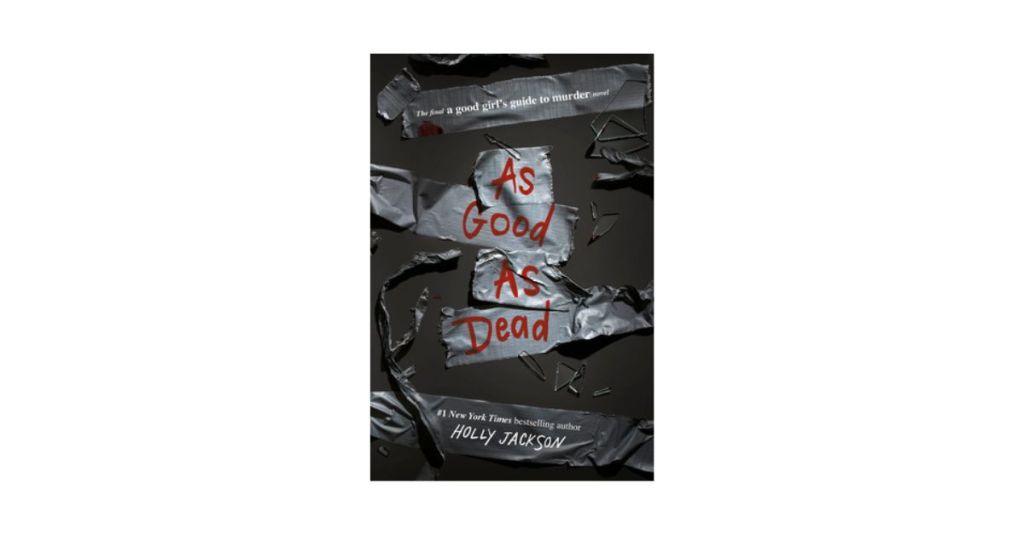
Holly Jackson’s “As Good as Dead” stands as the third and final book in the “A Good Girl’s Guide to Murder” series, following the young investigator Pip Fitz-Amobi.
What initially draws readers to this series is Pip’s intelligence, fearlessness, and relatable modern-day Nancy Drew demeanor. However, in this final installment, the narrative takes a sharp turn, departing from the established character dynamics and storytelling style that fans have come to love.
In this book, we rejoin Pip Fitz-Amobi as she grapples with the aftermath of her past investigations and the weight of post-traumatic stress disorder. Threatened and harassed since the release of her podcast, Pip encounters ominous messages that lead her to believe she’s being targeted by a potential serial killer.
As dead pigeons and mysterious chalk drawings start appearing near her home, Pip’s unease grows. However, the stakes escalate when she realizes the unsettling similarity between the present circumstances and the modus operandi of a serial killer who has been behind bars for six years, The Duct Tape Killer.
The plot follows her journey navigating personal trauma, attempting to decipher the cryptic threats, and facing the grim reality of her own mortality amidst a case that challenges her in ways she never anticipated.
Pip, the once-admired, strong-willed protagonist, feels incredibly out of character in this book. Her transformation is jarring, and it feels like reading about an entirely different person than in the first books. The drastic change in Pip’s demeanor, from a determined investigator to an angry, traumatized, and pill-popping protagonist, leaves readers disconnected from the character they once knew. Her entire personality and core beliefs change before the readers’ eyes; fans won’t recognize Pip by the halfway point.
The representation of post-traumatic stress disorder (PTSD) is an important aspect of Pip’s character development, yet its portrayal in “As Good as Dead” is too drawn out. Readers are in Pip’s head more than the real world and it significantly slows down the pacing.
The plot starts to get good a fourth of the way through the book. Though the mystery is predictable, the investigation feels like the first two books.
However, halfway through the book, the plot takes a disappointing turn with a major plot twist that, instead of adding depth, contributes to the downfall of the narrative. The entire second half of the book feels ridiculous, out-of-character, drawn out, and laughably unrealistic. There is a jarring shift in the tone and vibe of the book, splitting from what we know of the characters and their beliefs.
One of the highlights of the series is the meticulous links between the books, displaying a well-thought-out structure for the trilogy. While the plot of this book was impressively connected to the previous books, the sudden and significant shift in Pip’s character leaves much to be desired.
Another reason why fans love this series so much is the detailed investigative work that Pip does. Through investigations, interviews, and research, readers feel as if they are solving the mystery alongside her, making the book exciting and immersive. However, in this book the mystery is more of a side plot than the main focus of the story. It is over with barely any detective work.
The tone shift towards darker and grittier themes makes the book feel less suited for its young adult audience. The deviation from the established moral compass of the characters may disappoint readers expecting the same charm and appeal as the earlier books.
While the relationship between Pip and Ravi is initially a highlight of the book, it takes a disappointing turn along with everything else at the halfway mark. Ravi’s lack of personality and unquestioning compliance with Pip’s actions contribute to the weakening of their dynamic. The portrayal of their relationship dynamics appears toxic and unconvincing, failing to maintain the charm it once held.
“As Good as Dead” is an unfortunate departure from the series’ core strengths, leaving readers longing for the magic of the earlier books. Despite the series’ potential and promising beginning, this final book falls short of expectations, leaving a void in its wake.
If you’re a fan of the first two books, skip this one and pretend the series is a duology.
 meganbrownwrites.com
Leave a comment